What Does A ‘Science of Meaning’ Mean?
Hard Science tells two Creation stories. One about the emergence of Space, Time and planet Earth (Let there be Light); the other about the emergence of Animals and Plants (Let there be Life). But Science has a third Creation story to tell – about the emergence of meaning itself (Let there be Creation stories). And this is a story that has never been told.
But first, are we ready for this third story? Because if the physical and biological sciences are anything to go by, its impact could be as huge as that of the preceding two. In fact, greater, because whereas the ‘Book of Light’ and the ‘Book of Life’ look at the relatively neutral territory of the world around us, this third book will look directly at us. So the potential for conflict between this new creation story and the creation stories of the past will be massive. Pushing us into the dilemma suggested by this hypothetical t-shirt below.
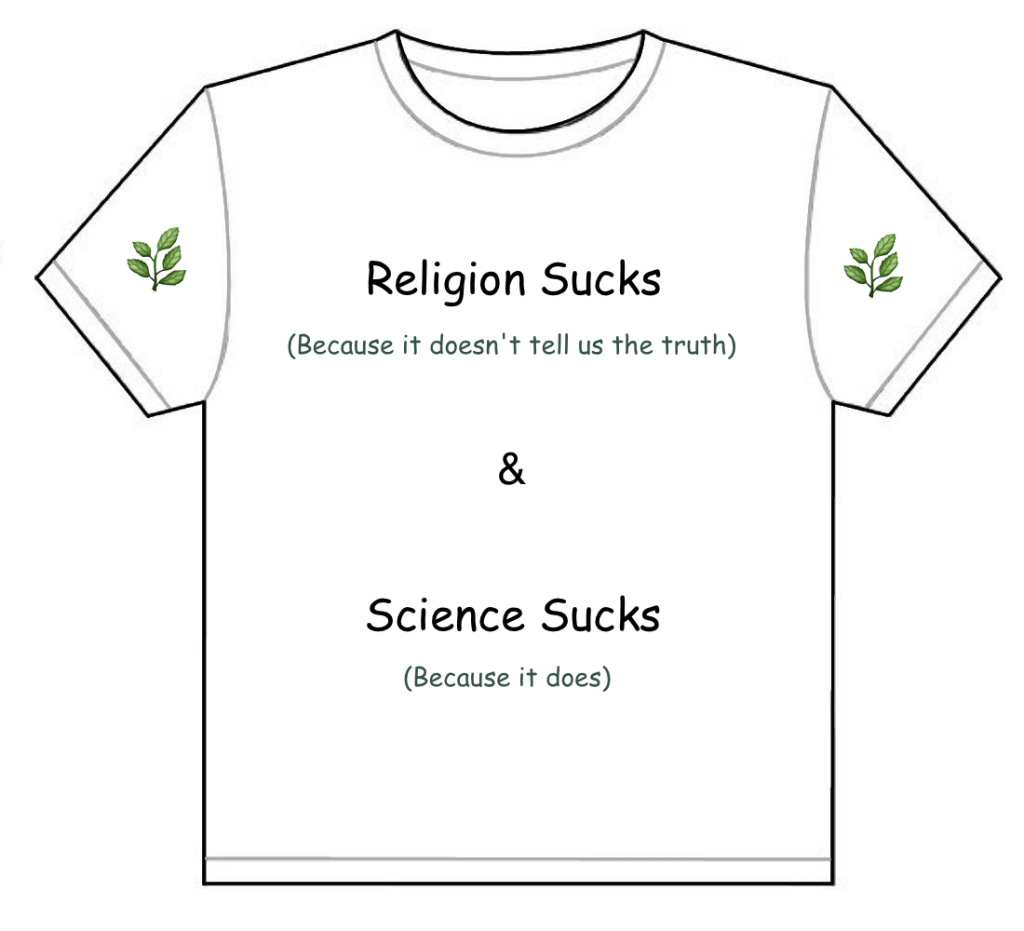
As you can see, this t-shirt does the opposite of damning science with faint praise, by ‘praising science with faint damn’. But the slogan is a serious one. For it addresses a predicament that faces the whole human race. A dilemma that is the result of the increasing education of mankind, and our increasing efforts to understand not just the nature around us, but our own human nature as well. Out of which comes a choice, and one that puts us between the devil and the deep blue sea. For we either stay with religious belief, to then lose out on much of the illumination that comes from science. Or we move to a third creation story about the nature of meaning, but then incur at least a partial loss of the very thing that we cherish most. Meaning meaning.
This is not to say that a life without religion is a life without meaning, as that is demonstrably false. But it is to say that religion is the main source of meaning for a large percentage of the human population, and that to remove it may leave many of us without the hope and comfort that we seek in life. So although some of the chief proponents of atheism bravely claim they are not afraid of death, and are happy to face the reality of the human condition on their own two feet, and that science therefore does not ‘suck’, this may not be representative of the rest of us. After all, we can see that it must be quite easy for such independent and important figures to think in this way, surfing as they are on the crest of a wave high above the rest of us, where the meaning removed by science is replaced by the undoubted success of their own lives. But for those of us down here on terra firma, it can be less easy to face the idea that meaning is merely a man-made thing. Which is to say that, in our short and often difficult lives, there is nothing more to life than the physical world, and what we ourselves make of it.
Having said that, it is also likely that none of us will have much choice in this matter in the long term, because just as the powers of the hard sciences made them ultimately irresistible (despite huge religious opposition in both the past, and now the present), so too will the third creation story pursue its inevitable destiny, whether we like it or not, and like its elder and highly successful brothers, create a brand new dawn.
So let us look at what this new story might be about, and do so by going back to a different sunrise: the dawn of human intelligence. A dawn that began with the evolution of the imagination on one hand, and of language on the other. A co-evolution that was, it seems, always bound to lead to the following, and inevitable reflection that:
‘There must be more to life than this!’
The ‘this’ being our increasing awareness of our physical condition, and the ‘must’ being our unstoppable desire to transcend it. Because it is precisely when ape turns to man, that the unavoidable and increasing consciousness of our condition is bound to lead to stories. Stories about how we got here, and where we are going, all in order to imbue our physical existence with greater meaning. Stories that will inevitably transcend our physical limitations by creating heroes that rise above the natural world to do things far beyond what is actually possible in real life. Stories that will exalt a scale of values that denies our animality, in order to idealise a set of behaviours that makes us quite distinct from the world of creatures around us. But most of all, stories that propose a super being, so that the meaning we have in our lives is no longer seen as merely a ‘man-made something’ but is, instead, a matter of human destiny, on a scale and grandeur with the stars themselves.
So where does all human meaning come from? Well, it emerges from the interaction between the physical reality of the world outside, and the imagined world inside our heads. Leading to a point where aspects of the natural world that are deemed undesirable can either be excluded or, at the very least, reinterpreted. Because once a group of fellow imaginations has established this virtual and collective world, then that is precisely the freedom that awaits them. (Just as long as the new stuff remains consistent with staying on the right side of the cliff edge, that is). A virtual world that represents a radical departure from the world of animal logic, and one that takes us humans in a dramatically new direction. Because it allows us to build a virtual reality that is often at variance with the world outside, creating strange beliefs and values that can flourish nowhere else, but the place inside our heads. All of which comes down to the fact that we live in not one, but two places.
We are in the World, and the World is in our Head

Now, because we live in two worlds, the fast developing world inside our heads was always bound to lead to conflict with the world outside. A conflict that was to generate vastly superior ways of coping with our biological imperatives through the power of science on the one hand. But a conflict that was also bound to generate many metaphysical beliefs, some of which were wildly at odds with the reality of the physical world outside. Beliefs that were highly compatible with the developing needs of human meaning inside our heads certainly, but nonetheless the stuff of fantasy on a grandly subjective scale. All of which served to create an uneasy balance between our acceptance of physical reality on the one side, and our radical denial of its dominion over this new world of ‘what might, could, and should be’, on the other.
These two worlds were bound to collide with each other eventually, and they were going to do so with a force that would change them both for all time. ‘Bound to’ due to the highly explosive relationship between the two different worlds within the ambit of human meaning. The one, with its hands and feet at home in the physical reality beneath its body, where it had mastery over the rest of the animal kingdom through the invention and use of many simple but powerful tools. The other, with its head firmly stuck in the clouds of the virtual space, where the ‘All There Is’ of physical reality was subsumed by the metaphysical beliefs of ‘All there could and might be’ of the other side of this new world of the imagination, buzzing between our ears. A virtual space that was for the moment in the throes of self creation, but which would, for a very long time, be dominated by the creation stories of religion, whilst the rest of human meaning hung in there, to survive or not under the faith bound aegis of the established order. Because other aspects of culture, such as everyday human morality, music, drama, art, poetry and writing, as well as the embryonic sciences were, for a very long time, forced to accept this dominion as their only way to survive. And then everything changed.
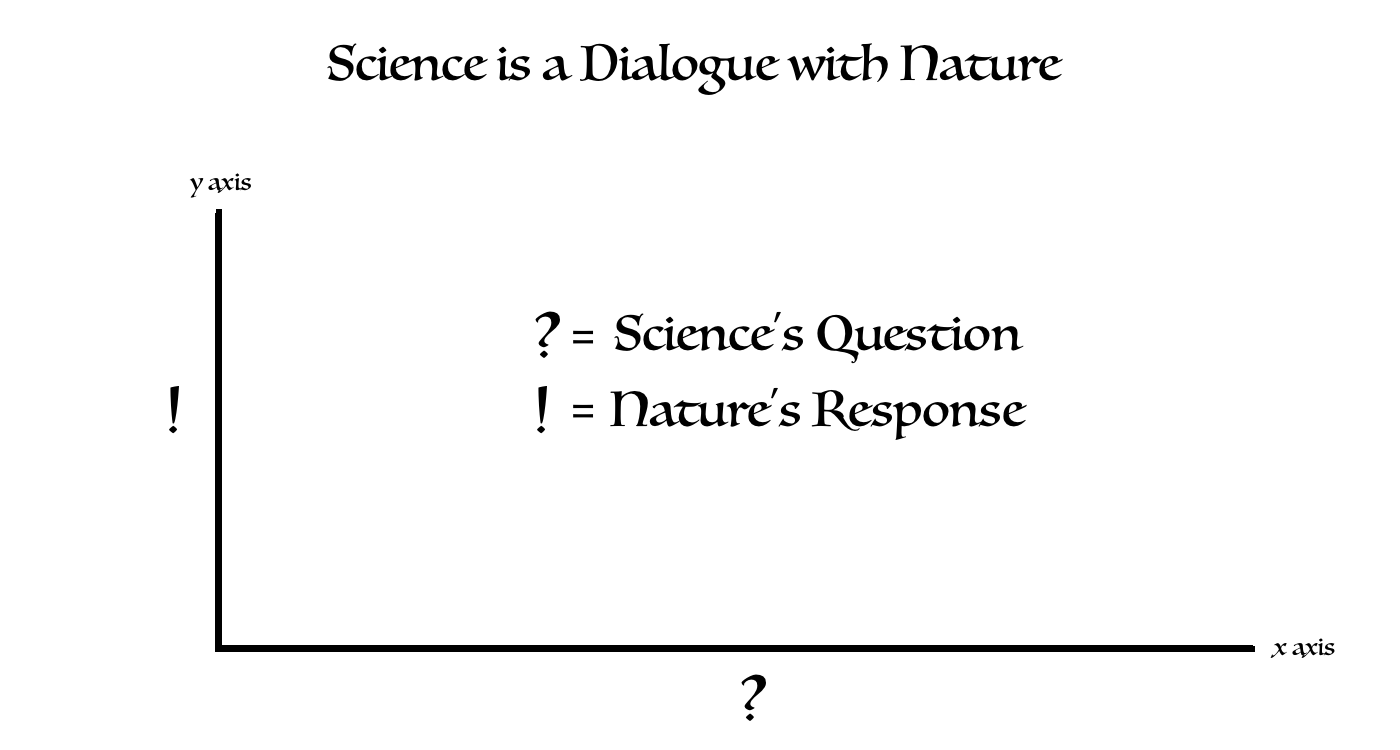
The change came out of an increasing disloyalty to the old order, based as it was on a faith that was nothing if not authoritarian. For now, emerging out of the cloud of human meaning, was an intellectual and physical force that, step by gradual step, was freeing itself from the dominion of dogma. A force that was to take us away from the illuminati of the dark ages – both paradox and irony intended. A force that was to tear a hole through the vision blocking fabric of faith to expose us to that much greater and alien darkness, the void (best seen when the moon is on the wane). For the physics of the universe is indifferent to the subjective fumblings of man, and once that vast box is opened wide, a set of previously unimaginable and transcendent powers fast becomes the property of the new wizardry that is the magic of science. A magic emerging from a relatively small band of people who have learned to converse with Nature – on its own terms, rather than on ours. A conversation of such moment that it would change everything – because Nature was responding to our questions, giving up its powerful secrets, and allowing us to tap into the deepest powers of the universe. A conversation based on the belief that the truth was out there, and that this truth was standing there, completely independent of human existence, and so entirely independent of human belief (again paradox intended). And yes, it’s time for another t-shirt.
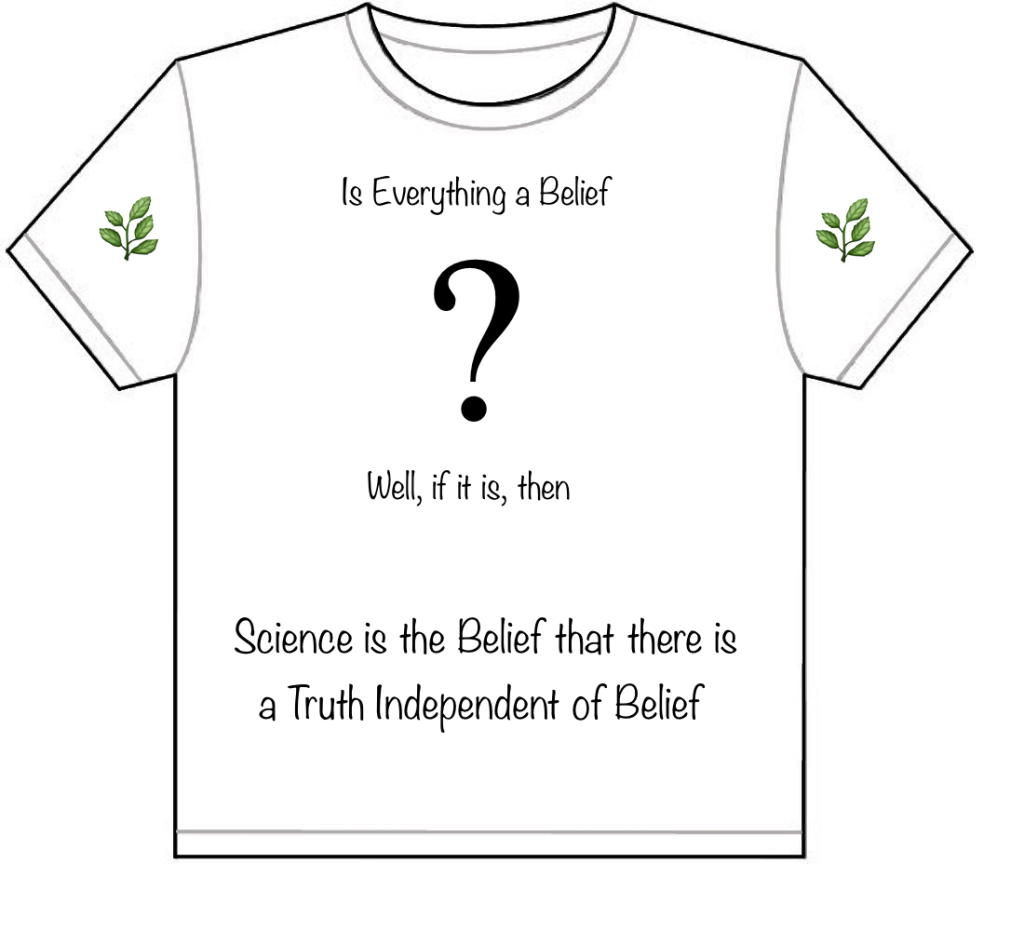
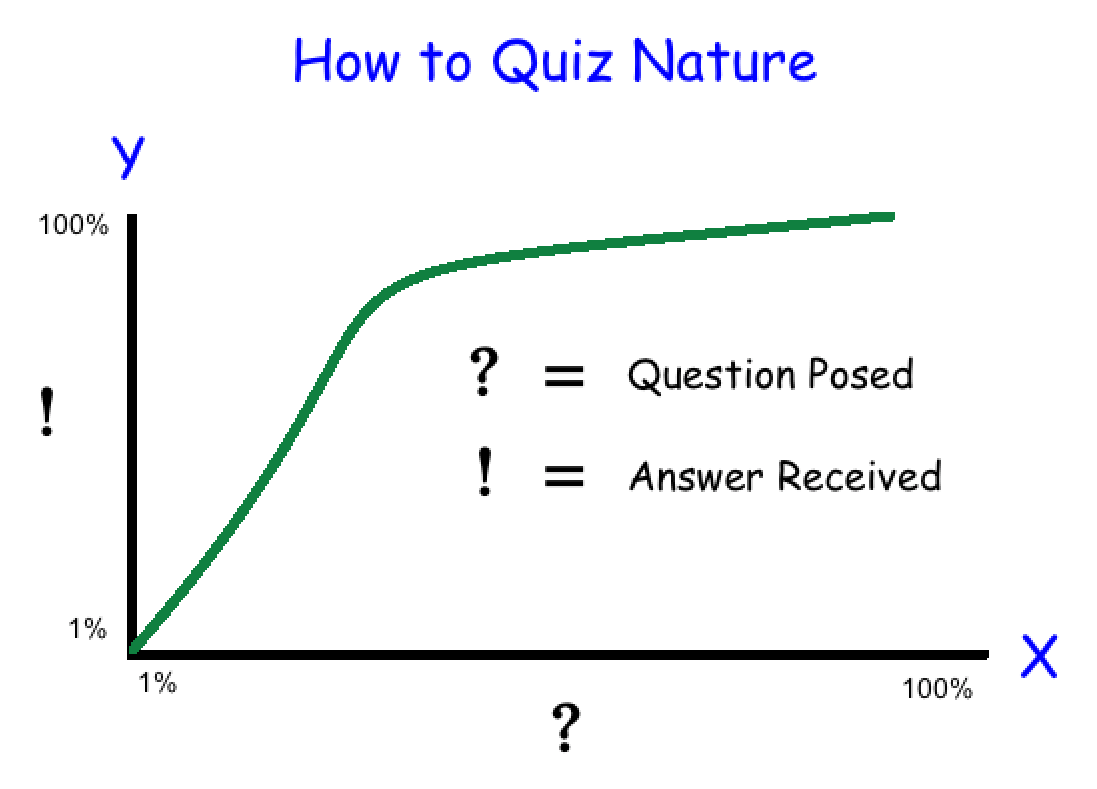
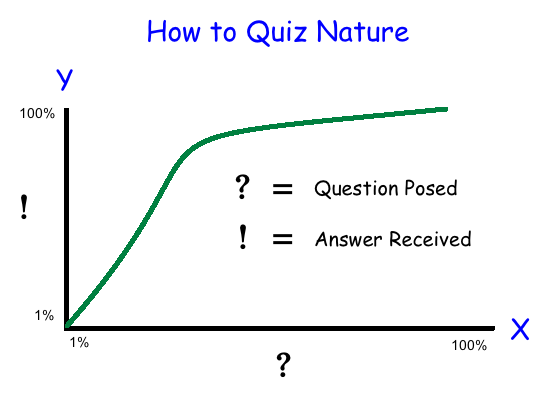
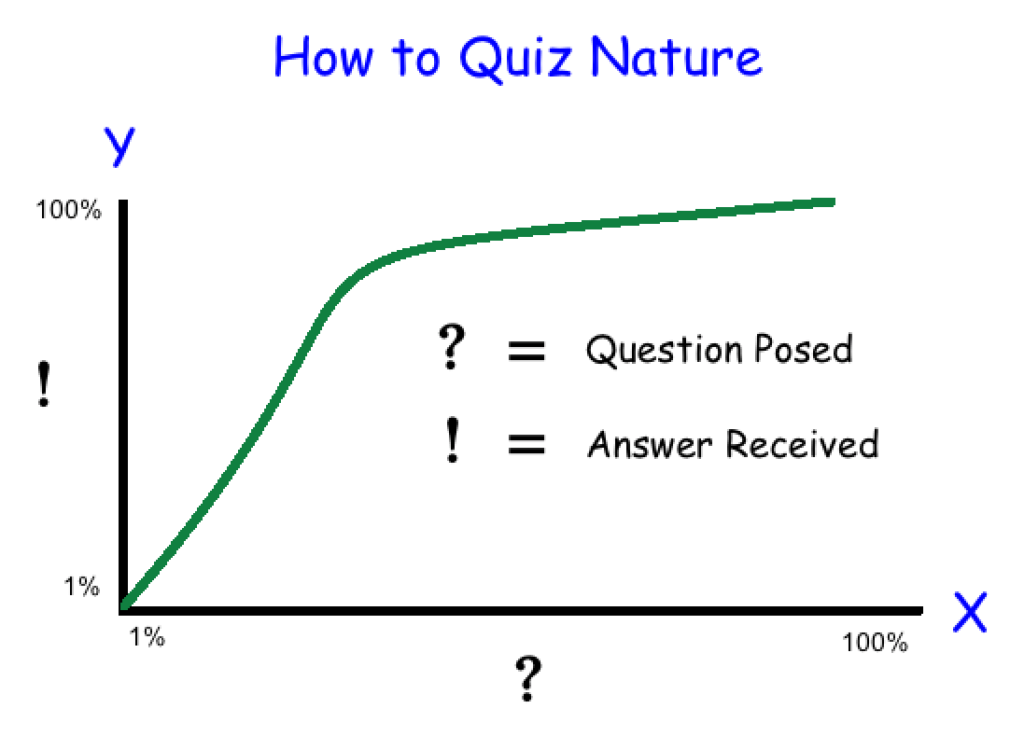
The idea that scientists are people who have learnt to talk to Nature certainly provides us with a powerful image. Suddenly that dry looking graph that summarises the results from an experiment turns into a real life dialogue between the scientist and the physical world (with the x axis, and its ‘independent variable’, as the question posed by the scientist, and the y axis, with its ‘dependent variable’ as the answer supplied by Nature). Always remembering that any good conversation can only work if we exclude the hubbub of other voices that might otherwise drown out our dialogue. So we shut them out by, as it were, closing the lab door on them (‘Other variables must be kept constant’). Having got control, we then ask Nature how it responds to different amounts of a condition of our choosing (represented by the x axis), and note the answer on the y axis.
Taking Nature on its own terms is a radical departure from looking at the world on our own, very human terms. However, most of the human race still finds it normal to take the substance of the physical world as a substrate for our own particular use. A substrate that can be transmuted, like water to wine, and then wine to the blood of a christ (or other mythical figure). For it is in this way, and through the millennia, that people have given a hostile world point and purpose. Creating a powerful mythology that persisted not just for the more obvious reasons (it offers hope, it serves the power elite, and as the church knows very well, children have no choice in the matter). But also because the ideas behind such mythology are intellectually exciting in the way they seem to challenge the natural order. So just as we find great stories, like ‘The Lord of the Rings’, compelling today, so the ancient myths that populate the rocks, trees, lakes and sky around us with the stuff of dreams and fantasy are totally compelling too. Changing, as they do, the world of Nature into a veritable stage set for all manner of human drama, hope and speculation.
The thing is, such thinking really did allow us to face both the problems of loss linked to our physical condition, and to revel in the exciting possibilities that arise from thinking that things might be otherwise than they are. However, this unfettered subjectivity was also at odds with the world outside, and when people learnt how to ask questions of nature, and how to understand the answers that nature gave, the powers released by an objective understanding of the universe became an unstoppable force. A force which led to the two creation stories that we have ironically entitled ‘Let there be Light’ and ‘Let there be Life’. A force that is now standing outside the door of that third great domain of reality on this planet – the landscape of human meaning. Presumably ready to map out the contours of this topography and establish a science of the human condition just as soon as it can.
The social or human sciences is the younger brother of the physical and biological sciences. But despite the wholly impressive success of these two older brothers, the younger brother has not yet come of age. In fact, it seems as if the social sciences are in the same position as the physical and the biological sciences were some centuries ago. So, for example, just as early biologists knew very little about the range of life around us, and even less about where it came from, so now, the social sciences have made no discoveries on the scale of a Darwin, Mendel, or Watson and Crick. At least not so far as the populace in general is concerned – which might be rather significant as although people know little about gravity or evolution, they certainly do know about people. So why is it that the social sciences are so silent on such fundamental matters as the nature of meaning, purpose and the human condition? Because surely it is the nature of meaning, together with its origins in our animal past, that presents us with the greatest question of all?
This leads us to a bit of a puzzle. Because if the world inside our head is the one place on this planet that we know really well, then how come we have never succeeded in mapping it? How is it that we have so far failed to chart the virtual contours of the landscape inside our heads, and produce an objective map of human meaning? (En passant, a map of meaning is not to be confused with the neurophysiological mapping of the brain). How is it that we have failed to achieve such a critical scientific goal when we are, all of us, such experts in the detailed semantic topography of our everyday life? Because clearly the social sciences; the one area of science that should speak to us about ourselves, has signally failed to tell us the one thing we all surely want to hear: which is the story of human meaning. So whilst the physical and biological sciences are now impressively mature bodies of insight and application, it seems that the social sciences are in their infancy, and have only just begun their ascent.
It is actually a real challenge to explain how it is that we can we do such amazing things as track the nature of distant suns, map tiny viruses, and locate elementary particles, but not know the geography of our own mental home; our own inside world of meaning. And not surprisingly, the answer to this puzzle is as interesting as it is important, so it is pursued in a later section in this website (look right now in ‘Off the Map’, in section two for some pointers if you like). But first let us be clear about what ‘Meaning’ means to us in terms of its overall importance. So, in a nutshell, meaning is about what matters to us, and although what matters to us may be of no interest whatsoever to the rest of the universe it is, to us, and this is no exaggeration, Everything.
An everything that we cling to tightly, making it hard to step back and look at objectively? Certainly. With a degree of complexity that makes an ecosystem look like a rockpool by comparison? It would seem so. Riven through with beliefs that admit no questionning? Definitely. A vast set of shifting sands that change not only from culture to culture but individual to individual? Again, it would seem so. Making the idea of actually mapping the landscape of meaning a huge challenge? Unquestionably. In fact, given all these obstacles, it is hard to know where to start. Because given the scale and undoubted complexity of this all encompassing ‘Everything’, the prospect of finding a point of leverage looks a little daunting. Especially given that this ‘Everything’ ranges from the most apparently specific and trivial issues (such as ‘What made us laugh today?’) to the most pervasive and profound questions about the human condition (such as ‘What is the point of existence?’). So where, in all of this hugely complex, rich and varied landscape of the human imagination; where can we possibly make a start? Well, let’s begin with what makes us laugh. And here is why…
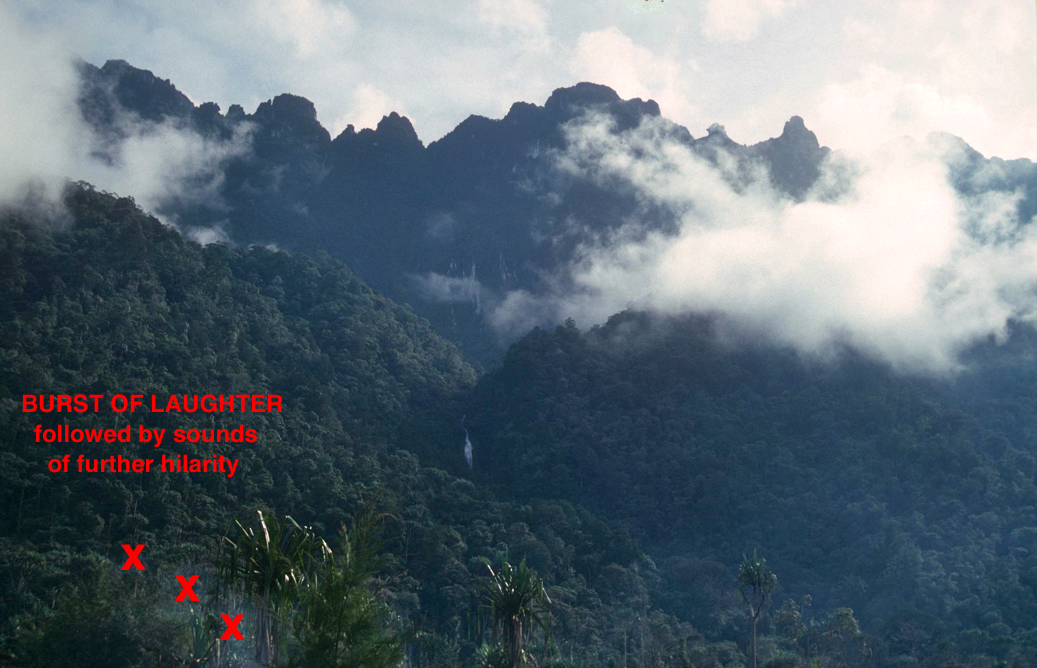
Imagine going back in time, and hovering over the forests of Earth, in a search of the first signs of intelligent life on this planet. Suddenly, amidst the usual sounds of the jungle, far down in the clearing below, we hear something extraordinary. Did we hear it right? Yes, there it is again. There’s no question about it – that was definitely the sound of laughter. At which point, and probably without further reflection, we identify this sound for what it really is. Namely, one of the vital signs that, without really knowing it, we have been looking for all along. An immediately recognisable sign that tells us we are in the presence of something really special and unique. We might even suggest that sound of laughter IS the sound of intelligence. For it is humour, perhaps more than anything else, that marks the point of change from animal to man. The point where the sparks from the glowing embers of our animal past have ignited into that new, and flaming power of intelligence that amounts to nothing less than the creative power and energy of the human imagination.
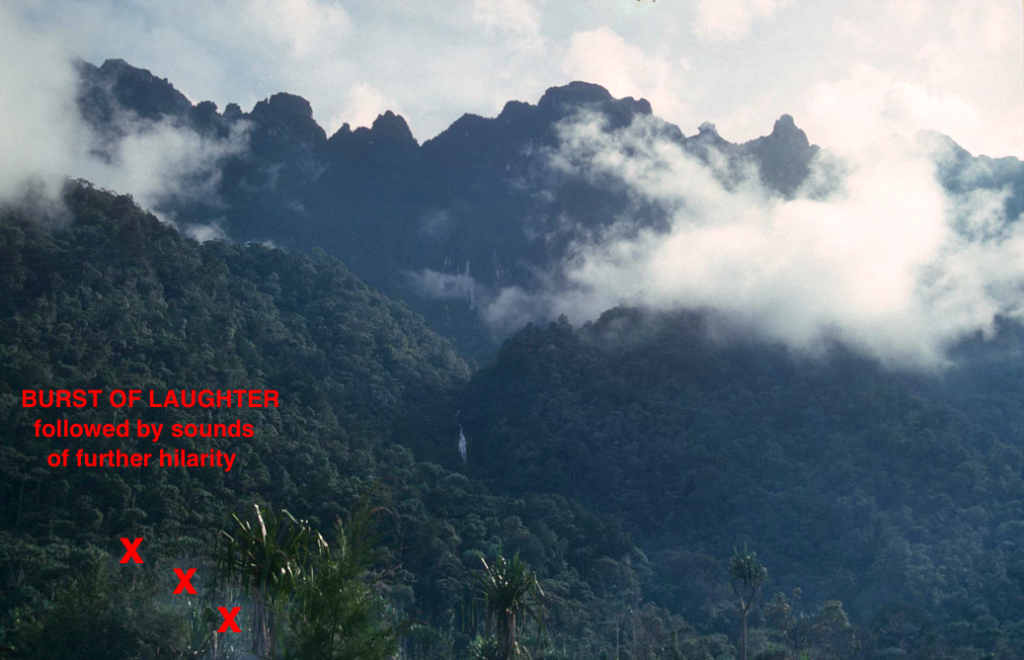
Well, the sound of laughter down below in the forest clearing does make for a powerful image of the dawn of intelligence. But it also happens to offer us a rather neat alternative to the ‘Let there be Creation stories’ in our opening paragraph. Because now we have an alternative version of the starting triplet:
Let there be Light – Let there be Life – Let there be Laughter
And ‘Let there be Laughter’ is better than ‘Let there be Creation stories’ for two reasons. Firstly, the sound of laughter really does make for a compelling symbol of the power of the imagination, and thus the dawn of human intelligence. And secondly, ‘Laughter’ begins with the letter ‘L’, which means that it fits in nicely with the other parts of our three part declaration, as they also begin with the same letter. All of which amounts to a new and satisfying way of summarising the three levels of reality on planet Earth. Satisfying because all three steps echo each other in a resonance based on the same sound, twice repeated. This in turn suggests that there is an underlying pattern to the whole formulation. Which, as we shall see in a later section, is indeed the case.
Okay, this is all very fine, and the echo of the alliterative ‘L’ is certainly quite pleasing, but we still have to answer the basic question that lurks behind all of this. Which is, why on earth should we start our quest to chart the landscape of meaning by enlisting the help of humour? After all, it is perfectly well known that jokes are indefinable, and don’t take kindly to analysis. Furthermore, the basic code that underlies any joke is still a complete mystery. So surely the idea of taking a jester on as our official guide is bound to lead us into trouble? In fact, given there are so many other aspects of meaning to choose from, why go for humour at all? Why not choose fiction, or religion or morality? Well, the answer to this question lies in the way jokes work.
Humour is special (apes may laugh, but humour is the crux here). We all know this to some degree, and understand its role in both entertainment and normal interaction. But the most exciting thing about humour is not its importance as a form of entertainment, nor its importance as a form of social exchange, nor even its importance as an intellectual challenge to the geographers of meaning. No, the real and fundamental importance of humour lies in the fact that it is a ‘science’ of the human mind in its own right. Or, to put it another way, humour is an intuitively inspired, colloquially expressed, and yet highly analytical precursor to the sciences of psychology and sociology. So it is for this reason, and for this reason particularly, that the joke deserves our full attention. Indeed, any scientific attempt to analyse meaning that focuses closely on the logic of humour is likely to be a success just because of this special feature. But this point only become clear when the nature of the joke and its action are considered more closely…
Jokes attack the boundaries and contour lines of the human landscape, momentarily twisting our cherished perceptions of the physical and social spaces that we live in. They do this by coaxing the objects and values of this combined experience into unfamiliar postures, positions and alliances. All of which means that the ‘twists’ that form the basis of this attack provide us with a graphic silhouette of the logic of human thought itself. Because by giving us a pointer to our most hidden perceptions, they furnish us with a clear and high-powered focus into the underlying nature of the human condition.
In fact, it is almost as if we humans have been looking at, and examining ourselves, from the very start of our evolution as conscious beings, and greatly enjoying our observations through this altered viewpoint in the process. A process that has probably employed many of the best creative minds in each generation, all of whom have sought to express their findings in the thousands of neat, recognisable units of simple language and design that we now call jokes. And together, these jokes comprise one of the biggest, and perhaps most objective body of material on the workings of the human mind in existence. A body of meaning that is especially useful to us not only because of its relative simplicity, but also because it has no other agenda than a loyalty to our intellect – which is to say that humour amounts to a relatively objective focus on our own human subjectivity, albeit expressed in the terms of colloquial language and behaviour.
How is it then that humour can survive as an objective force, especially when, as can sometimes happen, it attacks the established order of things? Well, it is surely the perceived triviality of the joke that enables humour to pursue this dangerous path, allowing it to roam free, unchallenged by the interests it so often attacks. In particular, it is this surface shimmer of inconsequence that has probably protected its existence in the past. But where in turn does this perception derive from? Why do we look on humour as a harmless activity? The answer seems to be that humour is seen as a benign force because it is almost entirely devoid of practical directives, has no particular agenda, and is far too fragmented to look like any kind of a serious movement. So humour has never been seen as a real threat to the power structures of society (except by those so rigid that any infraction anywhere is stopped at birth). That is, the shimmer of inconsequence that arises from this non threatening and chaotic identity is precisely the factor that has allowed humour to survive successfully, and without any really major constraints, throughout our entire human history. Meanwhile giving us an important outlet for our self awareness, and a lively freedom to be ruthlessly objective about our foibles and cherished traditions. Whilst at the same time allowing us to take it all with a pinch of salt, because none of it actually poses any danger to our normal lives, and to what we love and value the most.
To conclude then. Jokes twist the contours of our landscape of meaning, and through this action they reveal, at least for the moment of the joke, the underlying logic of human meaning. Which is why this quest takes on humour as its guide, and why much of this website is concerned with the nature and logic of jokes.
So. All we have to do is break the secret code of the joke (this has never been done before), and the underlying logic of the colourful domain of meaning will be revealed. That is, as long as we avoid the traps set by our jester guide along the way. And we really do have to break that code…